
Official announcementNVIDIA Newsroom
As AI Increases Demands on Memory, Storage Steps Up
Surging AI demands are driving the need for massive datasets and context windows that burst past the confines of system memory. But rising needs aren’t met by simply adding more storage capacity. What’s needed is useful, grounded insights from AI factories and efficient, secure s
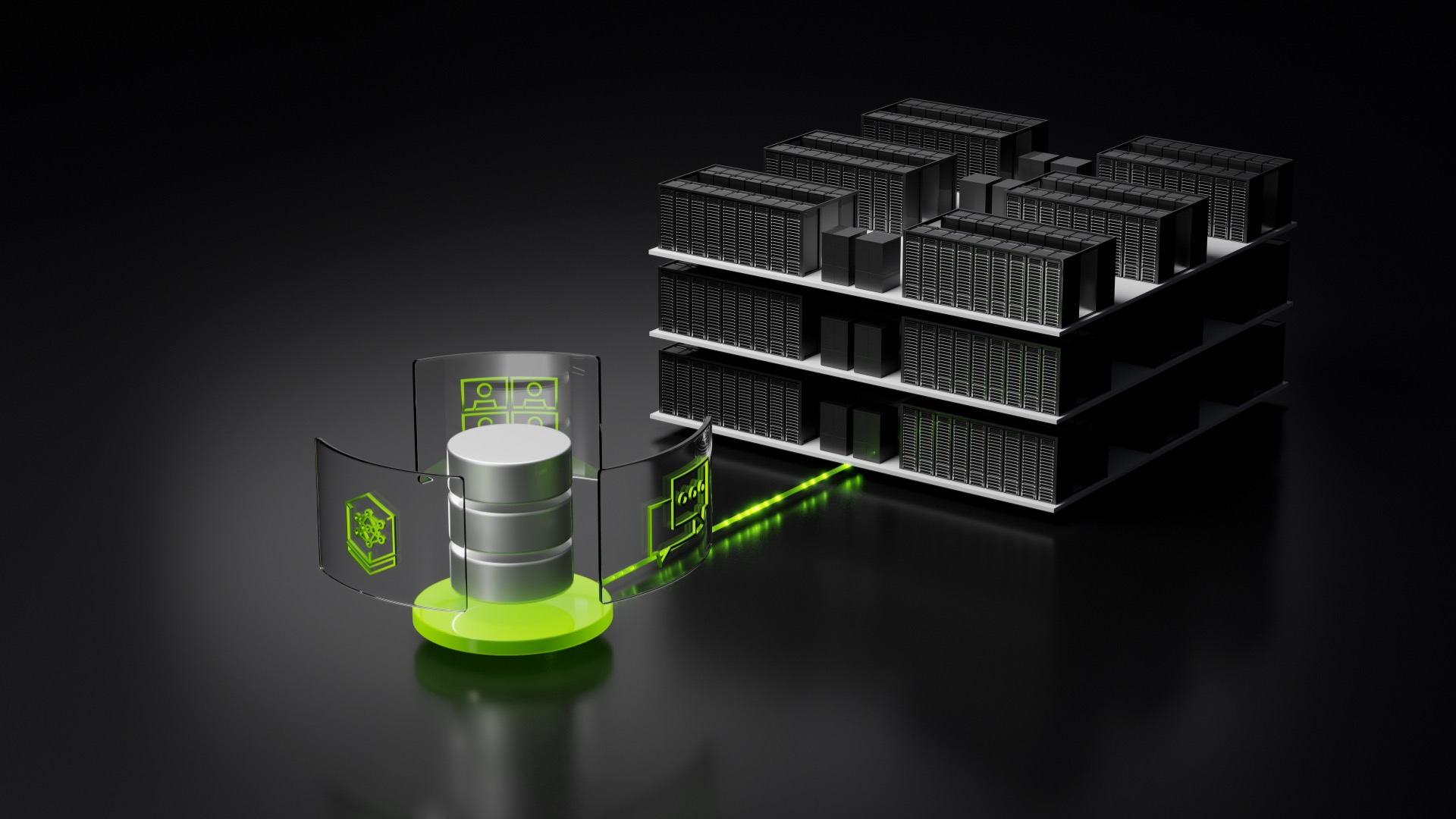
At FMS, NVIDIA shows how accelerated computing enables AI applications to access storage directly — fast enough to act like memory and secure by design.
August 4, 2026 by Jason Hardy
0 Comments
-
X
-
-
- [
Copy link
Link copied!
](#)
Surging AI demands are driving the need for massive datasets and context windows that burst past the confines of system memory.
But rising needs aren’t met by simply adding more storage capacity. What’s needed is useful, grounded insights from AI factories and efficient, secure storage architectures that enable those insights.
At this week’s Future of Memory and Storage (FMS) conference, NVIDIA is unveiling new storage advancements and showcasing how the next leap in AI depends as much on the storage infrastructure feeding accelerated computing as on the computing power itself.
The pressure on that infrastructure is intensifying as AI agents consume massive amounts of data — and GPUs can now initiate storage requests directly, generating thousands of concurrent operations.
To serve those requests, storage systems must continuously encrypt, compress, verify and reconstruct data. These critical data services can become bottlenecks when thousands of agents access storage simultaneously.
Benchmarks highlighted in this NVIDIA technical blog show that the NVIDIA Vera CPU, part of NVIDIA Vera BlueField-4 STX, delivers up to 3.21x higher throughput than an x86 CPU in a two-stage compression and encryption pipeline. This means that with Vera, storage platforms can absorb the flood of AI data more efficiently — delivering greater throughput with significantly less compute infrastructure.
With accelerated computing, storage stops being a passive place to keep data and becomes an active part of the data path.
This upends the old economics of determining when data belongs in memory (where applications can fetch it faster) versus on a storage drive (where it can be held in cheap and plentiful space). The tradeoff was first framed 40 years ago, when the answer was measured in accessing that data in minutes. On today’s GPUs, paired with AI storage solutions from NVIDIA and partners, the same tradeoff now plays out in microseconds.
Closing the gap between AI’s needs and memory shortage depends on extreme codesign across the whole ecosystem, from memory and storage manufacturers to the software built on them.
Open Source NVIDIA cuFile APIs Enable Interoperability for Storage Solutions
At FMS, NVIDIA announced it is open sourcing its cuFile application programming interfaces (APIs) — and the vertical storage software stack underneath them — which let GPUs, not just CPUs, read from and write to storage directly. cuFile is an open source component of NVIDIA GPUDirect Storage.
Using hundreds of thousands of GPU threads, fast high-bandwidth memory and other methodologies, cuFile enables securely accessing data from storage in just microseconds.
This represents how the industry is unifying a security-first storage stack based on Linux best practices, providing interoperability between GPUs and data.
In addition, fast, secure access to data and storage is a foundational element to powering preventive and detective cybersecurity measures. Making cuFile openly available will help make security context, data and storage accessible at the speed AI-powered defenses need. Such open technologies support initiatives such as the new Open Secure AI Alliance.
This site is the new home for APIs that are open to contributions — with Google, Intel, NVIDIA and Meta as inaugural maintainers — and can be optimized for use across various software and hardware platforms, driving innovation and efficiency for developers and enterprises.
NVIDIA and Industry Leaders Advance New Frontier of AI Storage
In addition, NVIDIA and storage industry leaders are optimizing memory and storage solutions through an initiative called Storage-Next. The NVIDIA-driven initiative brings together storage makers, controller vendors, thermal design, cooling and orchestration operators, and standards bodies to align on how GPU-driven storage should behave — then turn these advancements into interoperable, open industry standards.
Storage-Next includes over 40 leading storage and flash vendors — including DDN, KIOXIA and Micron — each contributing to the next generation of AI storage technologies with NVIDIA.
The initiative is grounded in accelerated data access for large AI datasets. To support this, NVIDIA offers SCADA — short for scaled, accelerated data access — a framework that lets massively parallel GPUs pull only the data necessary for the application directly from storage into their own high-speed memory.
For example, DDN is integrating SCADA with Infinia, its software-defined, AI-native data intelligence platform built to eliminate storage bottlenecks at scale.
“AI success will be defined not by how much infrastructure organizations own, but by how productively they use it,” said Sven Oehme, chief technology officer at DDN. “Our collaboration with NVIDIA is helping create a more direct, efficient connection between GPUs and data — keeping accelerated computing resources productive, speeding time to insight and enabling customers to achieve stronger business and financial returns from their AI investments.”
Storage-Next and SCADA extend NVIDIA’s longstanding work on AI storage infrastructure, including on NVIDIA Vera BlueField-4 STX — a modular, rack-scale foundation powered by the NVIDIA Vera Rubin platform, NVIDIA Vera BlueField-4 storage processors and NVIDIA Spectrum-X Ethernet networking.
NVIDIA Vera BlueField-4 STX storage processor.
Defining a new class of AI-native data platforms, NVIDIA STX uses the unified NVIDIA DOCA security stack to let enterprises enable continuous policy enforcement in the AI data path.
Plus, NVIDIA CMX Context Memory Storage provides an AI‑native context tier for long‑context, multi‑turn, agentic AI inference, built on NVIDIA STX.
SCADA Enables Fast AI Storage That Stays Secure
Speed at the storage layer comes with a catch. Letting an application talk straight to a drive is quick, but done carelessly, it can scribble over other processes’ memory — a security hole, not a feature.
NVIDIA SCADA uses a safe, robust method to achieve scaled direct access by splitting the job in two:
- The user parts of an application that need raw speed stay outside the trusted computing base.
- A separate, privileged component configures protected access between the user application and its approved storage at setup, adhering to standard Linux protocols for security enforcement while efficiently safeguarding data.
It’s all part of how advancements in fast, massively parallel, efficient, secure AI storage infrastructure can feed better data to applications and AI factories — so they can produce more useful, accurate, grounded intelligence at scale.
Join NVIDIA sessions at FMS, running Aug. 4-6 in Santa Clara, California, and learn more about NVIDIA AI storage.
See notice regarding software product information.
- Categories:
- AI Infrastructure
- Tags:
- Agentic AI
- AI Factory
- Artificial Intelligence
- Cybersecurity
- Events
- Hardware
- NVIDIA BlueField
- NVIDIA Rubin
- NVIDIA Spectrum-X Ethernet
- NVIDIA Vera
- Open Source
Related News
Gaming
GeForce NOW Gives Gamers More Ways to Play at Gamescom 2026
Aug 27, 2026
Gaming
Bring the Fire: Play Games on GeForce NOW With New Firefox Browser Support
Aug 20, 2026
Gaming
Class Is in Session: GeForce NOW Levels Up Linux, Chromebooks and More
Aug 13, 2026
Gaming
GeForce NOW Shakes Up August With 26 New Games
Aug 6, 2026
Related stories

Official announcement
Samsung Galaxy S26 FE: Delivering the Latest Flagship Experience, Focused on What Matters Most
Samsung Newsroom
Samsung Electronics today announced Galaxy S26 FE, the newest addition to the Galaxy S26 family and the first in the lineup to launch with One UI 9 — bringing the latest premium Galaxy experiences to more users from day one. With enhanced camera capabilities and more context-awar

Official announcement
Samsung Introduces New Odyssey Lineup for Fast-Paced Gaming at Gamescom 2026
Samsung Newsroom
Samsung Electronics today announced its 2027 Odyssey gaming monitor lineup at Gamescom 2026, the world’s largest gaming event, being held in Cologne, Germany from Aug. 26-30. The new lineup introduces multiple Odyssey models that feature world-first innovations, empowering player

Official announcement
How we saved 100 terabytes of memory by optimizing 1.1.1.1’s DNS cache
Sebastiaan Neuteboom
Big Pineapple , the platform behind 1.1.1.1 , Gateway DNS , DNS Firewall , AS112 , and several other Cloudflare DNS services, stores over 250 billion DNS cache entries at any given time. At that scale, wasting a single byte per entry costs more than 250 gigabytes of memory across

Official announcement
The Most Efficient Token Is One You Don’t Spend
Dell Blog
Why better enterprise data is the foundation of a more affordable AI future.

Official announcement
Scott Pilgrim EX: Bringing three new heroes to life in Back in the Band DLC
Eric Lafontaine
When we decided to reunite the full Sex Bob-omb lineup for Scott Pilgrim EX – Back in the Band, available now, we knew that simply adding three new playable characters wasn’t enough. Stephen Stills, Kim Pine, and Knives Chau each needed to feel like they had always belonged in th

Official announcement
The One-Trick Pony Problem: Why Best-of-Portfolio Beats Best-of-Breed
Dell Blog
The best single trick is no longer enough. Buyers want fewer vendors, fewer seams, and one accountable partner who can simplify complexity at scale.