
Announcements
# Funding better evaluations of AI’s impact on wellbeing
News summaryAnthropic News
Funding better evaluations of AI’s impact on wellbeing - Anthropic
Funding better evaluations of AI’s impact on wellbeing Anthropic
Pixabay (free commercial use)
Aug 25, 2026
We’re launching a $5 million grant program to fund independent research into how AI impacts users’ wellbeing. The program will provide direct funding, access to our models, and technical support to grantees building open-source evaluations that help the AI industry measure how our models affect those who use them. Grantees will work fully independently, and will publish their work as open-source projects that any developer can make use of.
AI systems have become central to how many people work, learn, and solve problems. They’ve also become conversational partners and can be sources of emotional support during difficult times. But as an industry, we are still working towards developing clear standards for how models should behave in these conversations, for example, when a user begins to seek companionship from a model, or uses AI to navigate a mental health crisis.
Furthermore, wellbeing is a particularly difficult area to evaluate. For most model behaviors, we can look at a single answer and determine whether it is accurate and appropriate. But assessing wellbeing requires much more context. For example, a user in distress might not share thoughts of self-harm right away; the need for a more cautious response might only become clear over the course of a long conversation. And a response that might be reasonable in one context might be harmful in another. For example, Claude might give advice on balanced diets and workout routines to a user who asks about losing weight, but if the user has demonstrated a history of disordered eating, that response could be inappropriate, and potentially actively harmful.
We work to develop safeguards to identify such conversations and help ensure Claude responds appropriately, and we publish research into the types of conversations people have with Claude to better inform how we develop our safeguards, how we evaluate them, and other measures we can take to protect users’ wellbeing. But these are nuanced considerations, and the stakes are significant. The right approach will need to evolve alongside our models and their uses.
By funding the creation of independent evaluations and benchmarks of user wellbeing, we hope to invite more people to lend their expertise to this emerging and critical field, including clinicians, psychologists, methodologists, and others.
Towards more effective wellbeing evaluations and benchmarks
As part of this program, we’re sharing guidance from our Safeguards team on what we believe makes a wellbeing evaluation rigorous enough to build on, along with the common challenges that can limit an evaluation’s usefulness.
In brief, we’re seeking evaluations that:
- State clearly what they are measuring (i.e., what counts as a pass or fail, and why it matters);
- Involve clinical and subject-matter experts in the design and validation;
- Test both precautions and harms (i.e., evaluate the risk of both overcompliance and overrefusal);
- Reflect how users actually use AI (often, this means constructing scenarios that represent multi-turn conversations, where risk escalates and context shifts over the course of a long conversation);
- Validate their graders against real subject-matter experts.
- To learn more about the grant program and apply, see our application form. For more on building strong wellbeing evaluations and benchmarks, read our guidance. Applications are due by September 21; applicants who are selected to submit full proposals will be notified by October 5.
Related content
Previewing the Model Hardware Standard
We’re opening a research preview of the Model Hardware Standard (MHS), a shared specification for AI agents to safely operate physical devices, to a first group of scientific research labs and advanced manufacturers.
Expanding our support for scientists
Starting today, 10,000 scientists around the world can get Claude at no cost to start. Verified principal investigators qualify for a Claude Team subscription plan and then add their research team to Standard seats for free, or Premium seats for $15 per month, for up to a year.
How Claude’s text watermark works
In this article, we share answers to some of the questions we’ve received about how our chosen watermarking method works, whether it affects Claude’s outputs, and why we’re making this change.
Related stories
News summary
Anthropic pushes into physical world with new standard to help AI agents operate machines - CNBC
Anthropic News
Anthropic pushes into physical world with new standard to help AI agents operate machines CNBC

Official announcement
AWS Elastic Disaster Recovery introduces Recovery Plans for orchestrated application recovery
AWS What’s New
AWS Elastic Disaster Recovery (AWS DRS) now offers Recovery Plans, a capability that automates the sequential launch of multi-server applications during recovery and drills. Instead of launching servers one at a time and tracking dependencies manually, you define the recovery seq

Official announcement
Giga-Scale AI and the Ethernet Evolution: How Spectrum-X Ethernet Rewrites the Rules
NVIDIA Developer Blog
The massive growth of generative AI has fundamentally altered data center design. As distributed model training scales to span hundreds of thousands of GPUs,... The massive growth of generative AI has fundamentally altered data center design. As distributed model training scales

Official announcement
How AI Coding Agents Can Unlock Materials Simulation with NVIDIA ALCHEMI Toolkit
NVIDIA Developer Blog
Atomistic simulation requires three things: knowledge of the science, compute-efficient implementation of simulations, and accessible interfaces to the... Atomistic simulation requires three things: knowledge of the science, compute-efficient implementation of simulations, and ac

Official announcement
How we saved 100 terabytes of memory by optimizing 1.1.1.1’s DNS cache
Sebastiaan Neuteboom
Big Pineapple , the platform behind 1.1.1.1 , Gateway DNS , DNS Firewall , AS112 , and several other Cloudflare DNS services, stores over 250 billion DNS cache entries at any given time. At that scale, wasting a single byte per entry costs more than 250 gigabytes of memory across
Official announcement
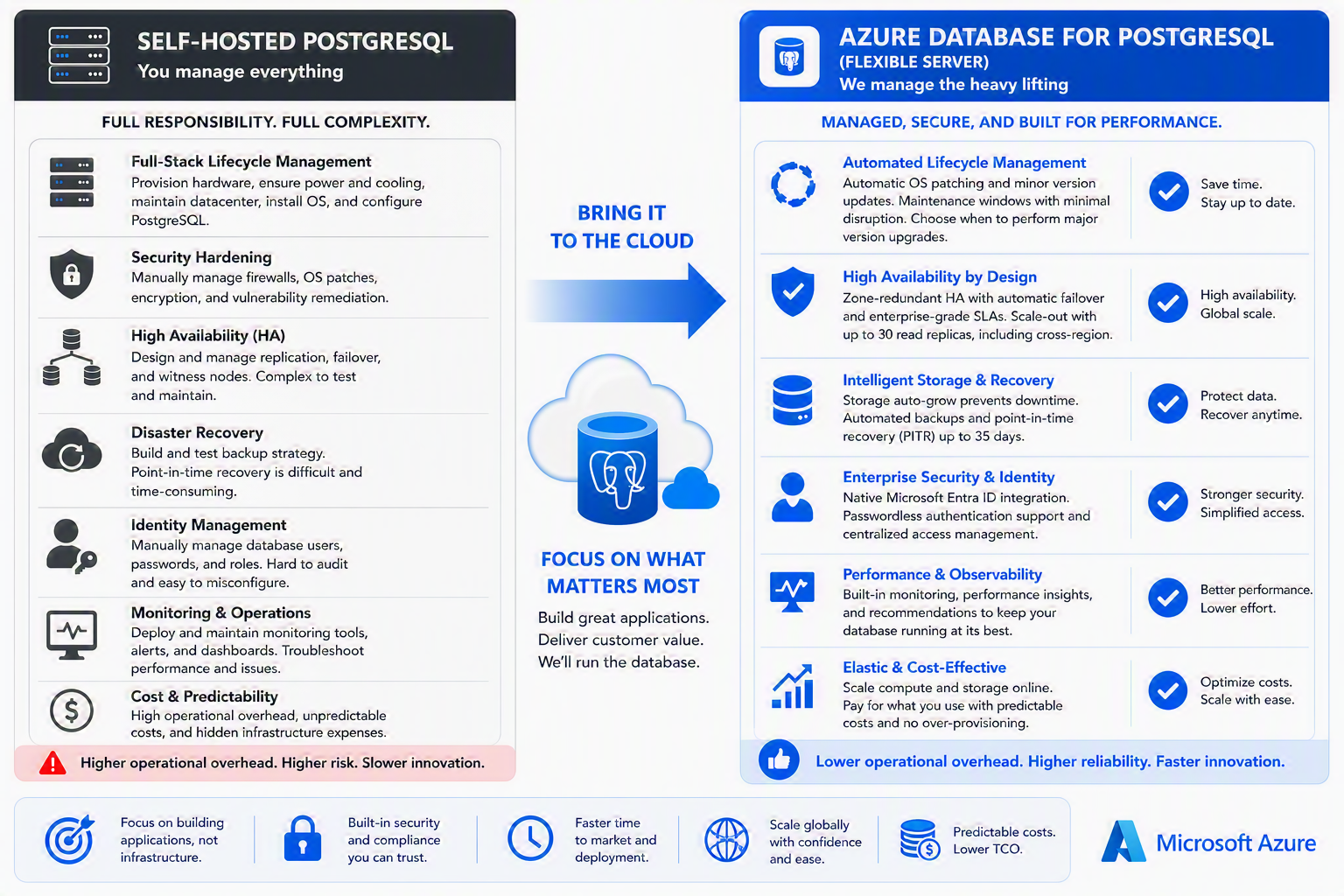
Managed PostgreSQL vs. self-hosted PostgreSQL: Key benefits and trade-offs
Lauro Ojeda
Summary This post is for technical decision makers evaluating where to run production PostgreSQL workloads. It compares two valid operating models—self-managed PostgreSQL and a managed database service—through business and operational outcomes: control, engineering capacity, resi