Alibaba released the model weights for Qwen3.8-Flash-Next as a preview of the upcoming Qwen4 architecture for developers to experiment with and evaluate. It’s a multimodal mixture-of-experts (MoE) model with a 125B-parameter main model supplemented by an additional 51B N-gram embeddings, with 6B parameters activated per token. It has a native 262,144-token context window, extensible to 1M tokens with YaRN.
Official announcementNVIDIA Developer Blog
Experiment with Qwen3.8-Flash-Next 176B Model on NVIDIA GB300 NVL72 for Agentic Coding
Alibaba released the model weights for Qwen3.8-Flash-Next as a preview of the upcoming Qwen4 architecture for developers to experiment with and evaluate. It’s... Alibaba released the model weights for Qwen3.8-Flash-Next as a preview of the upcoming Qwen4 architecture for develope

NVIDIA provides best-effort Day 0 functional support through SGLang, vLLM, and NVIDIA TensorRT LLM, validation across NVIDIA GB300 NVL72 for inference, and post-training recipes from NVIDIA NeMo AutoModel and NVIDIA NeMo RL.
Architectural innovations for long-context inference[](#architectural_innovations_for_long-context_inference)
Qwen3.8-Flash-Next is designed for high-volume, context-intensive applications such as agentic coding, document processing, and tool-driven workflows. As context grows, attention compute and KV cache memory become bottlenecks. The model addresses both with a hybrid architecture combining Gated DeltaNet (GDN) and Qwen Sparse Attention (QSA). Three out of every four layers use GDN to continuously compress historical context into a fixed-size recurrent state, eliminating KV cache growth as sequences lengthen. The remaining layer uses QSA for precise retrieval across the full context.
Previous sparse-attention approaches rely on token-level indexers that become increasingly computationally expensive as context length grows. QSA aggregates the sequence into micro-blocks, estimates their importance at the block level, and selects only the most relevant regions. This cuts attention, compute, and indexing overhead within each layer, making the design well-suited to architectures alternating between GDN and QSA layers.
Alibaba’s published benchmarks suggest that QSA can improve the efficiency of 1M-token workloads. Compared with full attention, its attention kernel delivered speedups of up to 7.6x during prefill and 4.9x during decoding. In a cache-heavy online serving test at a 1M-token context length and with a 90% prefix-cache hit rate, Qwen3.8-Flash-Next achieved 8.6x the prefill throughput of Qwen3.7-Plus.
Figure 1. Overview of Qwen3.8-Flash-Next showing three layers of GDN and one layer of QSA with MoE to reduce memory and compute for large-context inference
Related stories
News summary
Anthropic pushes into physical world with new standard to help AI agents operate machines - CNBC
Anthropic News
Anthropic pushes into physical world with new standard to help AI agents operate machines CNBC

Official announcement
AWS Elastic Disaster Recovery introduces Recovery Plans for orchestrated application recovery
AWS What’s New
AWS Elastic Disaster Recovery (AWS DRS) now offers Recovery Plans, a capability that automates the sequential launch of multi-server applications during recovery and drills. Instead of launching servers one at a time and tracking dependencies manually, you define the recovery seq

Official announcement
Giga-Scale AI and the Ethernet Evolution: How Spectrum-X Ethernet Rewrites the Rules
NVIDIA Developer Blog
The massive growth of generative AI has fundamentally altered data center design. As distributed model training scales to span hundreds of thousands of GPUs,... The massive growth of generative AI has fundamentally altered data center design. As distributed model training scales

Official announcement
How AI Coding Agents Can Unlock Materials Simulation with NVIDIA ALCHEMI Toolkit
NVIDIA Developer Blog
Atomistic simulation requires three things: knowledge of the science, compute-efficient implementation of simulations, and accessible interfaces to the... Atomistic simulation requires three things: knowledge of the science, compute-efficient implementation of simulations, and ac

Official announcement
How we saved 100 terabytes of memory by optimizing 1.1.1.1’s DNS cache
Sebastiaan Neuteboom
Big Pineapple , the platform behind 1.1.1.1 , Gateway DNS , DNS Firewall , AS112 , and several other Cloudflare DNS services, stores over 250 billion DNS cache entries at any given time. At that scale, wasting a single byte per entry costs more than 250 gigabytes of memory across
Official announcement
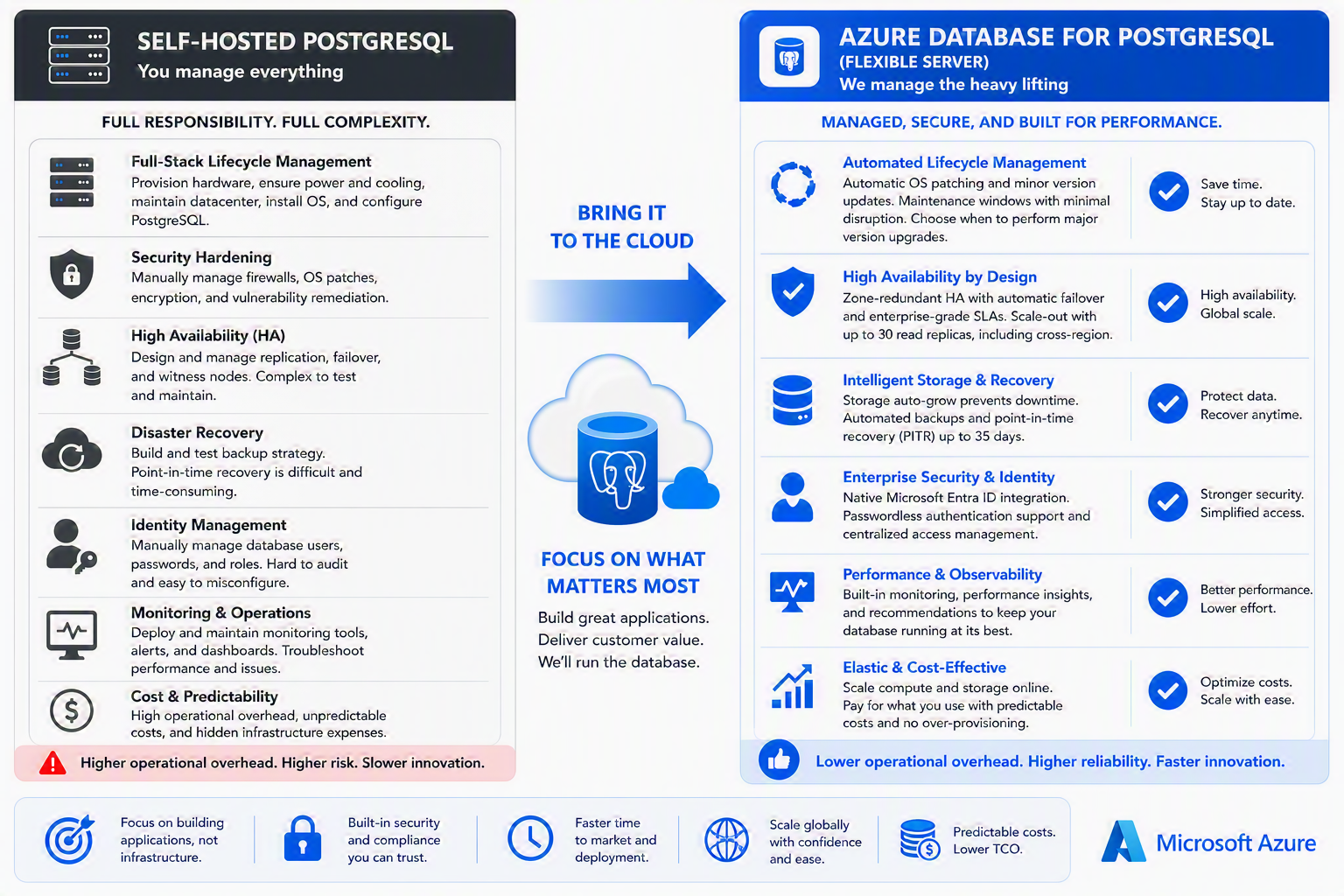
Managed PostgreSQL vs. self-hosted PostgreSQL: Key benefits and trade-offs
Lauro Ojeda
Summary This post is for technical decision makers evaluating where to run production PostgreSQL workloads. It compares two valid operating models—self-managed PostgreSQL and a managed database service—through business and operational outcomes: control, engineering capacity, resi