Alibaba released the open weights for Qwen3.8-2.4T-A95B (Qwen3.8-Max), its largest open-weight model, bringing near-frontier capabilities to the open ecosystem. It has 2.4T total parameters with 95B activated per token. It’s a fine-grained mixture of experts (MoE) architecture with a hybrid of full and linear attention, a context window of up to one million tokens, and an output length of up to 128K, designed for demanding reasoning and agentic workloads.
Official announcementNVIDIA Developer Blog
Serve Qwen3.8-2.4T-A95B, a 2.4T-Parameter Model, with Configurable Reasoning on NVIDIA GB300 NVL72
Alibaba released the open weights for Qwen3.8-2.4T-A95B (Qwen3.8-Max), its largest open-weight model, bringing near-frontier capabilities to the open... Alibaba released the open weights for Qwen3.8-2.4T-A95B (Qwen3.8-Max), its largest open-weight model, bringing near-frontier ca

Deploying a 2.4T parameter open-weight model requires data-center-scale accelerated compute. Inference at this scale depends on extreme co-design across chips, system architecture, and software. NVIDIA is working with the open-source ecosystem to bring the model to multinode deployments through optimized kernels, inference runtimes, and distributed serving recipes.
Without additional model tuning, the model achieves a throughput of over 4K tokens per second per GPU and over 350 tokens per second per user on NVIDIA GB300 NVL72 in FP8 precision on Day 0. Further optimizations, including NVFP4 precision, are expected to deliver enhanced performance gains over time.
Architectural innovations for long-context inference [](#architectural_innovations_for_long-context_inference )
Qwen3.8-2.4T-A95B is built for the hardest agentic workloads like coding, large-scale document analysis, and long-running multi-step workflows. Unlike chat-first models that send a single prompt and receive a single reply, agentic applications accumulate system instructions, tool outputs, retrieved documents, code, logs, and multi-step reasoning traces across a workflow. As context grows, attention, compute, and KV cache memory become the binding constraints.
The full-attention and linear-attention hybrid architecture addresses this, and the model alternates between the two. In the full-attention layers, every token attends to every other token, and in the linear-attention layers, the growing KV cache is replaced with a bounded recurrent state. Qwen3.8-2.4T-A95B keeps both compute and memory bounded as context scales to up to one million tokens.
Fine-grained MoE makes the 2.4T parameter count practical to serve. Instead of a small number of large experts, capacity is distributed across a larger population of smaller experts, improving specialization and routing efficiency per unit of activated compute. A learned router activates only the experts needed per token, so serving costs track active parameters, not the full 2.4T parameters, delivering frontier-scale capacity at a fraction of the cost of a comparable dense model.
Built-in reasoning controls (low/high/xhigh) enable developers to configure inference depth per request, trading compute for reasoning quality depending on the task: dial up for complex multi-step reasoning or dial down for high-throughput document processing.
Figure 1. Overview of the Qwen3.8-2.4T-A95B linear gated delta networks plus full attention with fine-grained MoE architecture
Related stories
News summary
Anthropic pushes into physical world with new standard to help AI agents operate machines - CNBC
Anthropic News
Anthropic pushes into physical world with new standard to help AI agents operate machines CNBC

Official announcement
AWS Elastic Disaster Recovery introduces Recovery Plans for orchestrated application recovery
AWS What’s New
AWS Elastic Disaster Recovery (AWS DRS) now offers Recovery Plans, a capability that automates the sequential launch of multi-server applications during recovery and drills. Instead of launching servers one at a time and tracking dependencies manually, you define the recovery seq

Official announcement
Giga-Scale AI and the Ethernet Evolution: How Spectrum-X Ethernet Rewrites the Rules
NVIDIA Developer Blog
The massive growth of generative AI has fundamentally altered data center design. As distributed model training scales to span hundreds of thousands of GPUs,... The massive growth of generative AI has fundamentally altered data center design. As distributed model training scales

Official announcement
How AI Coding Agents Can Unlock Materials Simulation with NVIDIA ALCHEMI Toolkit
NVIDIA Developer Blog
Atomistic simulation requires three things: knowledge of the science, compute-efficient implementation of simulations, and accessible interfaces to the... Atomistic simulation requires three things: knowledge of the science, compute-efficient implementation of simulations, and ac

Official announcement
How we saved 100 terabytes of memory by optimizing 1.1.1.1’s DNS cache
Sebastiaan Neuteboom
Big Pineapple , the platform behind 1.1.1.1 , Gateway DNS , DNS Firewall , AS112 , and several other Cloudflare DNS services, stores over 250 billion DNS cache entries at any given time. At that scale, wasting a single byte per entry costs more than 250 gigabytes of memory across
Official announcement
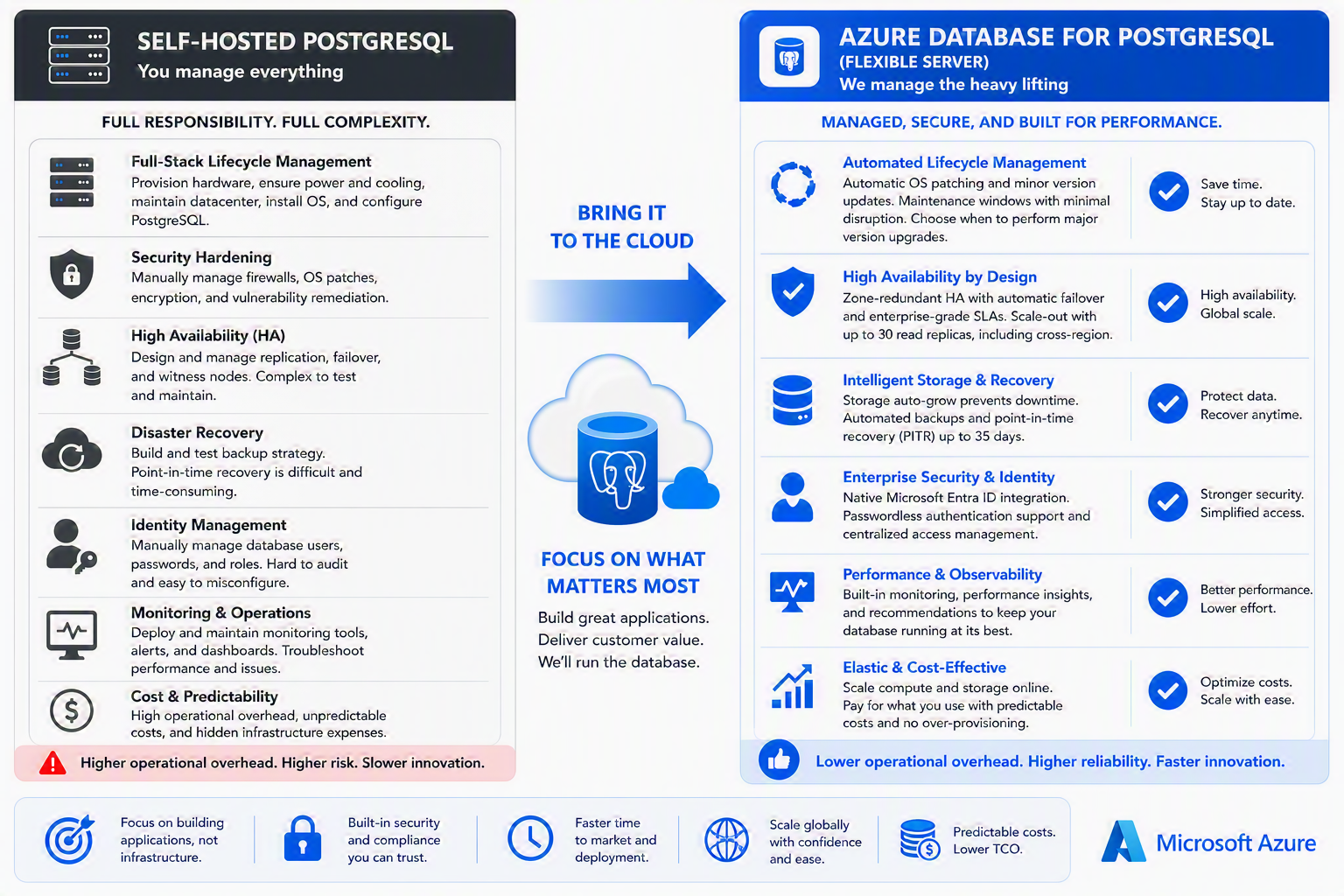
Managed PostgreSQL vs. self-hosted PostgreSQL: Key benefits and trade-offs
Lauro Ojeda
Summary This post is for technical decision makers evaluating where to run production PostgreSQL workloads. It compares two valid operating models—self-managed PostgreSQL and a managed database service—through business and operational outcomes: control, engineering capacity, resi