Aug 12, 2026
Official announcementGoogle Pixel Blog
How your Pixel Watch steps in if you stop breathing
Breathing emergency detection calls emergency services when you stop breathing so you can get potentially life-saving care.
|
-
x.com
-
-
- [
Mail
](mailto:?subject=How%20your%20Pixel%20Watch%20steps%20in%20if%20you%20stop%20breathing&body=Check out this article on the Keyword:%0A%0AHow%20your%20Pixel%20Watch%20steps%20in%20if%20you%20stop%20breathing%0A%0ABreathing emergency detection calls emergency services when you stop breathing so you can get potentially life-saving care.%0A%0Ahttps://blog.google/products-and-platforms/devices/pixel/pixel-watch-breathing-emergency-detection/)
-
Copy link
Breathing emergencies can happen to anyone — and they're especially dangerous when a person becomes unresponsive and can't call for help. Breathing emergency detection on Pixel Watch can detect these events and automatically call emergency services, potentially saving lives.
Pramod Rudrapatna
Senior Product Manager, Google Health
Tajinder Gadh
Principal Software Engineer, Android
-
x.com
-
-
- [
Mail
](mailto:?subject=How%20your%20Pixel%20Watch%20steps%20in%20if%20you%20stop%20breathing&body=Check out this article on the Keyword:%0A%0AHow%20your%20Pixel%20Watch%20steps%20in%20if%20you%20stop%20breathing%0A%0ABreathing emergency detection calls emergency services when you stop breathing so you can get potentially life-saving care.%0A%0Ahttps://blog.google/products-and-platforms/devices/pixel/pixel-watch-breathing-emergency-detection/)
-
Copy link
Your browser does not support the audio element.
Listen to article
[[duration]] minutes
This content is generated by Google AI. Generative AI is experimental
Voice
Speed
Voice
Speed
0.75X
1X
1.5X
2X
When a breathing-related emergency — like severe pneumonia, accidental drug overdose, or choking — causes a critical drop in oxygen saturation, a person can rapidly become unresponsive and unable to call for help.
These types of emergencies can be reversible — but only if someone knows the emergency is happening, intervenes, and calls for help. But many of these emergencies happen when there’s no one around.
A first of its kind, opt-in feature on Pixel Watch, breathing emergency detection
[
1
](#footnote-1)
can offer a lifeline by recognizing when a person’s blood oxygen level drops dangerously low. If they become unresponsive, it automatically calls emergency services
[
2
](#footnote-2)
and their emergency contacts so they can receive potentially life-saving care.
[
3
](#footnote-3)
The science and design behind the feature
Breathing emergency detection uses an advanced, AI-based algorithm to analyze signals from your watch’s heart rate, motion, and altitude sensors. To try and minimize accidental check-ins, it verifies that you’re in a low-motion state without rapid altitude changes.
[
4
](#footnote-4)
And to reduce false notifications from conditions like sleep apnea, it also confirms that you haven’t been asleep for more than 30 minutes.
[
5
](#footnote-5)
The mechanics of the notification
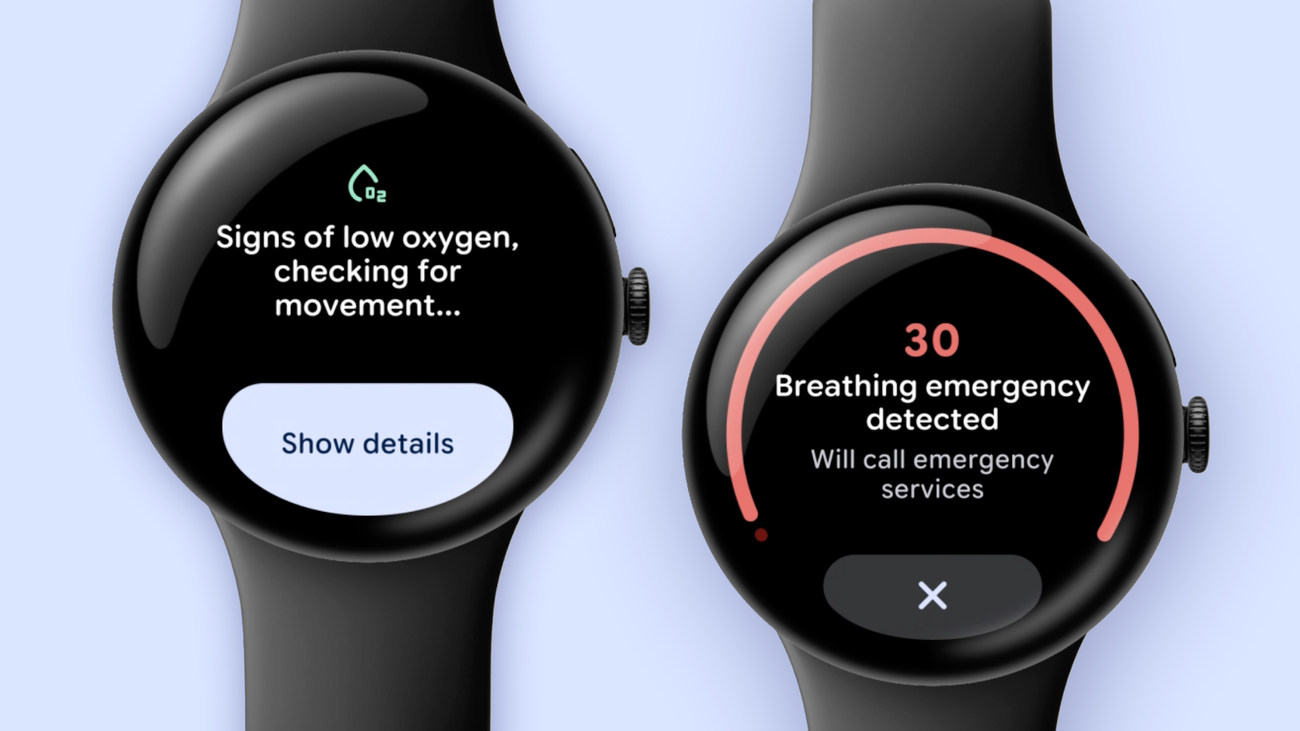
If the algorithm thinks you’ve stopped breathing, it initiates a phased escalation to get help while giving you the chance to cancel. First, it triggers a strong haptic vibration and a full-screen visual notification. If you don’t dismiss the notification, an audible alert will sound and a 30-second countdown begins. If the countdown ends without a response, the feature automatically prompts your connected phone or LTE-enabled watch to call emergency services. Once the call is connected, an automated voice message informs the emergency operator that a breathing emergency was detected. It explains that you aren’t responding and shares your precise location. If you’ve set up emergency contacts, the feature sends a message notifying them that you may need help.
The future of personal safety
Developing this responsibly required rigor. Because breathing emergencies are time-sensitive, they can’t easily be tested in everyday settings. So we collaborated with internal medicine doctors, cardiologists, anesthesiologists, and emergency medical experts to understand how oxygen loss presents in the body. We then used those critical details to shape the technology.
To ensure the technology works when it matters most, we tested the algorithm in clinical labs, where volunteers safely simulated emergency conditions under medical supervision. We also tested it against hundreds of thousands of hours of real world data to eliminate false alarms from sleep apnea or quiet rest. Then we worked closely with emergency medical services and public health leaders to ensure our alerts worked within existing emergency response systems.
Breathing emergency detection reinforces our commitment to building technology that's helpful when it matters most. It’s the latest addition to our suite of advanced safety features, which also includes Loss of Pulse Detection.
Through medical collaboration and extensive real world testing, breathing emergency detection can bridge the gap between everyday technology and life saving intervention. It is a fundamental step forward in making personal safety proactive and accessible.
It’s available now on Pixel Watch 4 and 5 in several European countries,
[
6
](#footnote-6)
including Austria, Denmark, France, Germany, Ireland, the Netherlands, Norway, Sweden, Switzerland, and the U.K. We’ll continue working to make the feature available in more countries soon.
[
7
](#footnote-7)
Pixel Watch 5 is available for preorder now and will be on shelves August 20, starting at $399 (41mm) and $429 (45mm).
Get the latest news from Google in your inbox
Sign up for our newsletters with product updates, event information, special offers, and more.
Done. Just one step more.
Check your inbox to confirm your subscription.
You can also subscribe with a different email address.
Your information will be used in accordance with Google's privacy policy. You may opt out at any time.
Posted in:
Related stories
Official announcement
Samsung Galaxy S26 FE: Delivering the Latest Flagship Experience, Focused on What Matters Most
Samsung Newsroom
Samsung Electronics today announced Galaxy S26 FE, the newest addition to the Galaxy S26 family and the first in the lineup to launch with One UI 9 — bringing the latest premium Galaxy experiences to more users from day one. With enhanced camera capabilities and more context-awar

Official announcement
Giga-Scale AI and the Ethernet Evolution: How Spectrum-X Ethernet Rewrites the Rules
NVIDIA Developer Blog
The massive growth of generative AI has fundamentally altered data center design. As distributed model training scales to span hundreds of thousands of GPUs,... The massive growth of generative AI has fundamentally altered data center design. As distributed model training scales

Official announcement
How AI Coding Agents Can Unlock Materials Simulation with NVIDIA ALCHEMI Toolkit
NVIDIA Developer Blog
Atomistic simulation requires three things: knowledge of the science, compute-efficient implementation of simulations, and accessible interfaces to the... Atomistic simulation requires three things: knowledge of the science, compute-efficient implementation of simulations, and ac

Official announcement
Samsung Introduces New Odyssey Lineup for Fast-Paced Gaming at Gamescom 2026
Samsung Newsroom
Samsung Electronics today announced its 2027 Odyssey gaming monitor lineup at Gamescom 2026, the world’s largest gaming event, being held in Cologne, Germany from Aug. 26-30. The new lineup introduces multiple Odyssey models that feature world-first innovations, empowering player

Official announcement
How we saved 100 terabytes of memory by optimizing 1.1.1.1’s DNS cache
Sebastiaan Neuteboom
Big Pineapple , the platform behind 1.1.1.1 , Gateway DNS , DNS Firewall , AS112 , and several other Cloudflare DNS services, stores over 250 billion DNS cache entries at any given time. At that scale, wasting a single byte per entry costs more than 250 gigabytes of memory across

Official announcement
The Most Efficient Token Is One You Don’t Spend
Dell Blog
Why better enterprise data is the foundation of a more affordable AI future.